
When the Land Names the Harvest: The Story of Pulau Salaka

A simple pastry pouch sitting on a retail shelf usually tells you very little about where it came from. It might list weight, flour ratios, and an expiry date, but it rarely reveals the landscape that fed it.

In Karangduwur, a coastal village tucked into the rugged hills of Ayah, Kebumen, a small cookie pouch tells an entirely different story. It carries a name that existed long before our project began, long before our ovens arrived, and long before the cooperative baked its very first batch.
That name is Salaka.
According to the spoken memories passed down among residents, this coastal stretch was once known as Pulau Salaka. Today, the area is firmly rooted to the southern mainland of Java, surrounded by steep ridges and the sweeping blue arc of Menganti Beach. Yet, the old name never truly disappeared. It lingered in the air like sea mist, waiting for someone to listen.
When the women of Karangduwur gathered to develop their first commercial product, they did not look outward for a modern marketing angle. They reached back into the earth beneath their feet and borrowed a name from their own soil.
Borrowing Instead of Inventing
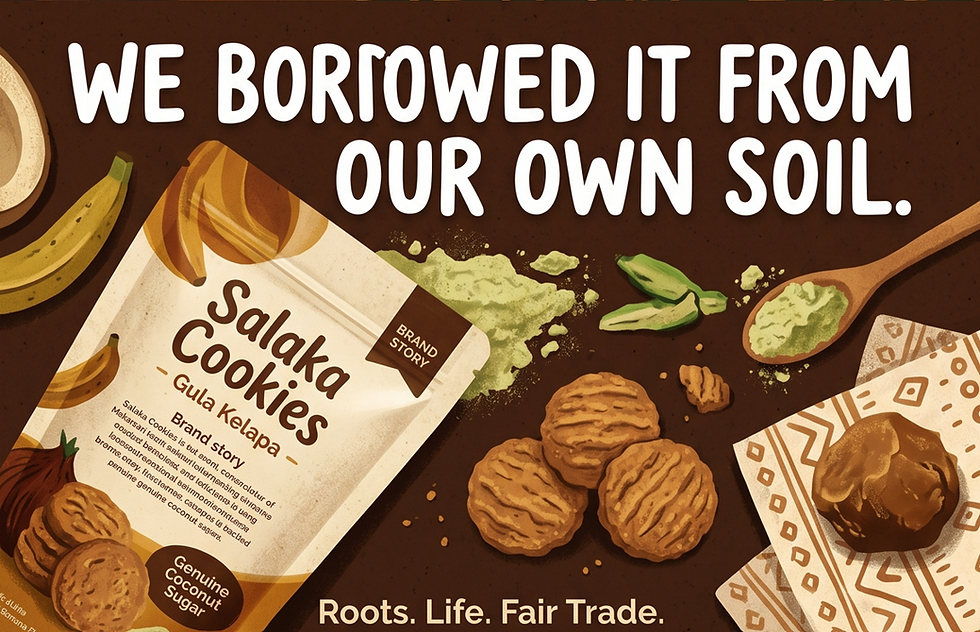
Small village enterprises often feel pressured to adopt glossy, foreign-sounding brand names to appear modern or credible. Many initiatives believe that to move forward, they must leave their local identity behind.
Our movement took the opposite direction.
When the women of Koperasi Produsen Sinergi Mekarsari Lestari began crafting their signature cookies, they chose to revive a heritage title that belonged to their ancestors. They understood that true value is not something imported from an external design agency. True value is dug up from the ground you walk on every day.
This decision mirrors how the community treats the surrounding environment. In conventional enterprise models, progress often begins by felling trees, clearing wild ground, and building something synthetic to take its place. In Karangduwur, the philosophy works the other way around.
The community works with what already stands. They borrow the forest canopy for shade, harvest fallen seeds without harming the branches, and build businesses around standing life rather than extracted timber. Borrowing the name Pulau Salaka followed that exact same logic: use what is already alive in the place, honor it, and let it sustain you.
What Lives Inside the Pouch
Salaka cookies were never designed to be generic factory sweets. They were created as a distinct Kebumen souvenir, developed directly from the coastal region's tastes and traditional treats.
Instead of relying on refined white sugars and industrial fillers, the women turned to local agriculture:
Genuine coconut sugar: Sourced from local palm farmers, giving the cookie a gentle, earthy caramel note that carries the warmth of village kitchens.
Locally milled banana flour: Sourced from green bananas that grow abundantly along forest borders, milled directly by cooperative members to create a naturally gluten-free base.
Sorghum flour: Cultivated as a hardy dry-land grain, processed by the women to offer a rich, nutty crumb that anchors the texture.
Today, the cooperative maintains three active product variants: Cookies Original, Cookies Tepung Sorghum, and Cookies Tepung Pisang.
Every pouch holds more than flour and sugar. It is an edible map of Karangduwur, gathering the forest edge, the palm groves, and the rocky soil into a single crisp bite.
The Hands at the Center of the Kitchen
A good recipe means nothing without people to carry it. The real backbone of Salaka is not a formula; it is the women who run the cooperative.
At first, the baking was an uphill battle. Early batches emerged from the ovens either as hard as river stones or so fragile they dissolved into dust before reaching a pouch. Proportions fluctuated, heat varied, and trial after trial missed the mark.
Rather than walking away, the women treated each failed tray as practical instruction. Supported by culinary training from the Kakarak team in Bandung, they practiced strict kitchen protocols, balanced ingredient ratios, and standardized their baking curves.
By early 2026, those kitchen experiments became a disciplined, stable production system. A core team of three women, rotating regularly, now produces approximately 65 pouches, or about 6.5 kilograms of cookies, per cycle.
These women are not project beneficiaries waiting for instructions. They are independent managers running their own business. They own the cooperative bank accounts, set their production days, and handle daily operational decisions.
Even the product's original visual identity was drawn by their own hands before professional graphic guidance ever stepped into the village.
As Siti Barokah, who oversees sales distribution for the cooperative, explained: "For sales, we consign our products at Menganti Beach tourist spots and local shops, and we have introduced them to government offices in Kebumen. They have been received warmly because we use natural palm sugar and avoid artificial preservatives."
Financial management followed the same path of steady self-reliance. Siti Rodiyah, the cooperative treasurer, noted the change in her own daily work: "After attending financial reporting classes with the Balwana team, step by step I began to compile the cooperative balance sheets myself."
The Living Canopy: Keeping the Forest Upright
The journey of Salaka cookies connects directly to a larger ecological truth: a forest is worth far more standing alive than cut down.
In the coastal hills of Karangduwur, government-owned coastal tamanu forests stretch across the slopes. For generations, rural economies were told that income required clearing woodland for timber or quick mono-crops. The cooperative proved that claim wrong.
The native tamanu trees remain untouched, acting as a sturdy green umbrella against harsh ocean gales and torrential coastal rains. Underneath that living canopy, farmers plant shade-loving crops like turmeric, ginger, and bananas.
The forest provides moisture and shelter; the farmers protect it from clearing and fire. When the women harvest the bananas to mill into cookie flour, they generate steady income without felling a single branch.
The cookie is not an isolated product made in a kitchen; it directly guards the canopy above it. Every pouch sold gives the community another practical, economic reason to keep their forest alive.
The Return of a Name
Pulau Salaka began as an old story whispered through village homes, a memory of a time when the sea and the land met differently.
We borrowed that name from the earth because it reminds us who we are. It reminds us that sustainable development does not mean wiping the slate clean to make room for something foreign. It means having the patience to listen to the soil, trusting local hands, and building an economy where nature and people grow strong together.
The old island has returned, not as an isolated rock in the surf, but as an enduring engine of community resilience.
The next time you travel down the winding roads toward Menganti Beach, stop at the local cooperative stalls. Pick up a pouch of Salaka cookies, feel the weight of the harvest inside, and taste the honest story of a forest that remains standing tall.


Comments