
Salaka Cookies: How a Failed Batch Became a Women-Led Local Snack Brand
- Muhammad Aufa Sabili
- Jul 7
- 5 min read


The first batches of Salaka Cookies were not good.
Some came out too hard. Others fell apart before they made it into a pouch. Lina and Sartini, working alongside Siti, Reni, and Siti Barokah, kept ending up with cookies that tasted fine but never came out the same way twice. They would adjust the ratio, try again, and get a different result.
They did this for months, in a small production room in Karangduwur, with Mr. Sumedi mentoring them through each attempt.
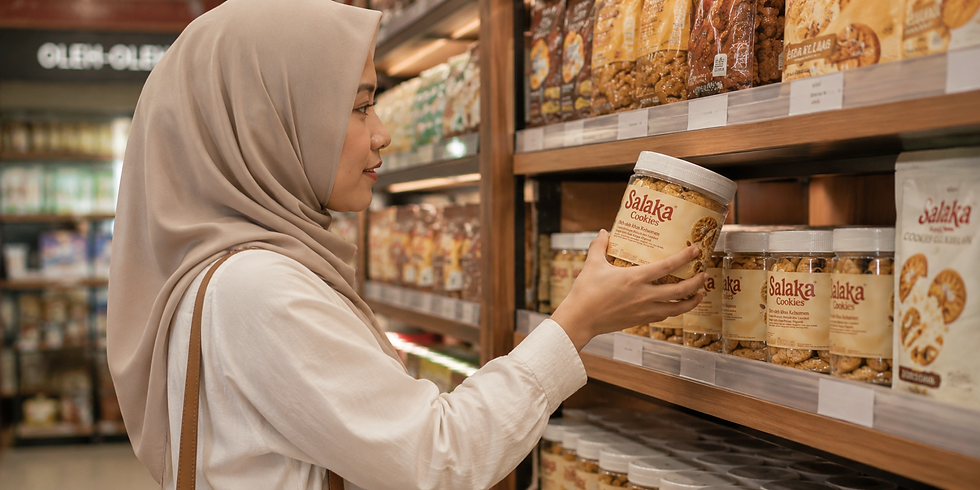
Today, Salaka Cookies sit on souvenir shelves near Menganti Beach, in retail stores and hotels, and at the Kebumen train station. They have a name drawn from local history, packaging with a brand story printed on the back, and a production system that produces roughly 65 pouches per cycle. This is the story of how that happened — and what it actually took.
The name behind the brand: Salaka Island
Before it was Karangduwur, this area was known locally as Salaka Island. That name carries weight in the community — it is part of how people here understand where they come from.
When the cooperative needed a name for their cookie line, they didn't reach for something generic. They named it Salaka. The packaging tells this story directly: a brand built on local heritage, not on a marketing template borrowed from somewhere else.
This matters for more than sentiment. A product that carries a place's name and history gives buyers something to remember and something to ask about. For a cooperative-made cookie brand competing for shelf space in a tourism economy that draws roughly a million visitors a year to Kebumen, that story is part of the product.
From trial and error to standardized production
The breakthrough did not arrive as a single moment. It built slowly, through a long stretch of trial and error that the women treated as a working method rather than a problem to get past.
They measured ingredients more carefully. They tracked what changed between a good batch and a bad one. They tested again. With consistent mentoring, what started as five women guessing their way toward a workable recipe gradually became a structured production process — one with defined steps, proportions, and an outcome.
By early 2026, that process had matured into something the cooperative could rely on. Texture became consistent. Ingredient proportions were standardized. Output became stable, cycle after cycle. A team of three core producers, rotating through the work, now produces approximately 65 pouches — about 6.5 kilograms — per cycle.
That number on its own might not sound like much. It represents the difference between a recipe that sometimes works and a product that always does. Going from trial and error to standardized production is the quiet, unglamorous work that makes everything else — packaging, branding, distribution — possible. Without it, there is nothing to sell consistently.
Where the cookies go now?
Standardized production only matters if there is somewhere for the product to go. For Salaka Cookies, which has grown steadily somewhere.
The cookies are sold through consignment in souvenir shops around the Menganti Beach tourist area, in retail stores, in hotels, and at the Kebumen train station — places where the local heritage story on the packaging meets exactly the kind of buyer who is looking for something to take home.
They have also travelled further than Karangduwur itself. The cooperative brought Salaka Cookies to the Market Day bazaar in Yogyakarta in 2025, and to the Ramadan Fest bazaar in Semarang in 2026, where they represented the Regional Forestry Office for the Kebumen–Purworejo region under the Central Java Provincial Environment and Forestry Agency.
Over 100 units sold within 6 months. For a cooperative-made cookie brand from a forest village, reaching shelves and festival stalls outside the village is not a small step. It is evidence that the product can hold its own once it leaves the place of manufacture.

Innovation, the women didn’t wait to be told to do
Once the core Salaka Cookie was standardized, the producers didn't stop there. They started experimenting with variants — on their own initiative, using what was already around them.
The first was a klepon cookie, made with locally sourced coconut and pandan from the village. Klepon is a familiar flavor profile in Indonesian sweets, and putting it into a cookie format was the kind of local ingredient product innovation that comes from people who understand both the tradition and the product they're building.
The second is still in progress: a gluten-free variant made from locally produced banana flour. This wasn't assigned to them as a development target. It came from the producers themselves, looking at what grows around Karangduwur and asking whether it could serve as a raw material to reduce the cooperative's dependence on ingredients sourced from outside the area.
The cooperative's current target is at least three product variants built on local ingredients, up from the single original Salaka Cookie. Two are already in motion. That trajectory — from one product to a small but growing family of products, each rooted in what the area actually produces — is what product diversification looks like when it's driven from inside the cooperative rather than designed for it.
What standing up a brand actually required
None of the visible parts of Salaka Cookies — the packaging, the logo, the shelf presence — exist independently of a less visible layer of infrastructure that had to be built first.
Two new ovens with larger capacities were procured to support higher production volumes. Supporting kitchen equipment was added. The main production facility underwent renovation: the leaking roof was repaired, the lighting was improved, and a water supply system was installed. None of this shows up in a photo of a cookie pouch, but all of it is the reason the pouch exists at all.
On the brand side, the cooperative worked on packaging design, brochure development, and sales planning — the kind of work that turns a product made by a group of women in a village kitchen into something that, on a shelf, looks like it belongs there.
This is the part of the story that rarely gets told, because it isn't dramatic. But it's the part that determines whether a good product stays a one-off success or becomes something that can be made again, reliably, by a rotating team, indefinitely.
What's next: the 80-pouch target
The cooperative's current production capacity sits at around 65 pouches per cycle, managed by three rotating producers. The target is at least 80 pouches per cycle, with an expanded production team.
Getting from 65 to 80 is not the same kind of problem as getting from inconsistent batches to a standardized recipe. The recipe is solved. What's left is an organizational question: how do you bring more women into the production process without losing the consistency that took over a year to build?
That's a different kind of work — training new producers to the same standard, building in quality checks that don't depend on having the same three people in the kitchen every time, and making sure the increase in volume doesn't come at the cost of the texture and proportions that took so long to get right.
It's a good problem to have. It's the problem of a product that's ready for more people to want it than the cooperative can currently supply.


Comments